Posts

Saturday 26th August 1916
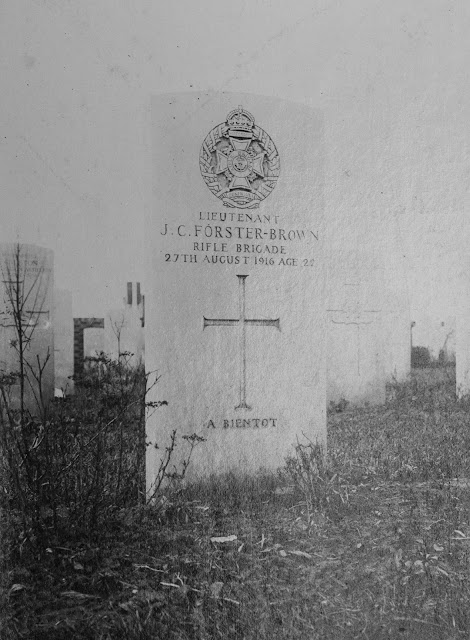
Image
A letter from W.B. Turnbull dated Monday 28th August 1916 described what had happened on the Saturday 26th August. " Mr. Forster Brown was badly wounded on Saturday evening and I am sorry to say that he died soon after we arrived at Hospital, and I wish to send you the deepest sympathy of all the men of the 12th Battalion who have known Mr. Forster Brown so long and I am sure we have lost an officer who was deeply respected in the Batln. as he was so fearless and brave. Mr. Maltby was also wounded by the same shell and I am sorry to say he died a little later. " Lieut. Col. H.L. Riley wrote,  " Personally I have lost one of my best officers and one whom I can never replace. He had only taken over command of the company a short time and had proved himself quite invaluable. A chance shell fell right into the mess and killed or wounded all the officers of the Company and the Adjutant. I saw him just after, but he was quite unconscious and did not suffer any pain. He was alw...

Cameron

Image
Cameron Forster Brown, born 13 September 1893, was the younger brother of Doris, later Doris Ives Smith whose pen name was Catherine Ives . Their parents were Marion Wintle and Thomas Forster Brown, a mining engineer, of Stoke Bishop, Bristol.  Cameron went to school at Aysgarth, Winchester and Clifton College before going on to Caius College, Cambridge. He became firm friends with Ashley Smith , his brother in law. Here below are some photographs of Cameron at school and age about 21 on joining the army. Cameron at school Cameron at Cambridge and on joining the army, age 21

Cameron Forster Brown and his letters from the trenches

Image
Cameron Forster Brown (1893-1916) was my grandmother's brother. The two of them were very close. At the outbreak of WW1, he enlisted in the Cambridgeshire Regiment, obtaining a commission in November 1914 in the 12th Battalion Rifle Brigade .  Portrait of James Cameron Forster Brown in uniform The 12th battalion was part of 20th Light Division, which on 22 August 1916, relieved 24th Division on the Somme near Delville Wood, after an unsuccessful attack on Guillemont. 20th Division found itself under heavy German attack in horrific conditions as described in The History of the Rifle Brigade in the War of 1914-1918:  " On the night 25/26th, when the Division side-stepped five hundred yards to the right, the Tenth Battalion came into a sector of trenches of a horror that can hardly be imagined. Not merely was the front line impossible to be held: it could only be approached by men of the most iron fortitude. The position was dangerously exposed to fire from the village; but that ...